Osaka guide
Umeda (Kita), Osaka: the city’s vertical north
A polished, high-speed Osaka district of station tunnels, sky views, department-store feasting and back-alley smoke, where the rails do half the talking and the alleys do the rest.
 By Yui Morimoto

Umeda is where Osaka goes vertical. Stand outside Osaka Station and the city feels less like a street map than a machine: five railways converging, glass towers rising, and an underground network so sprawling locals call it the Umeda Dungeon. Then turn one corner, pass a shrine gate, and the soundtrack changes to clinking glasses and yakitori smoke. That’s the trick here. Umeda can look all polished stone and escalators, but it still knows how to hide a good, slightly grubby night out behind the shine.
What Umeda (Kita) is known for
This is Osaka’s transport heart and its shopping capital, and it wears both jobs with a kind of brisk confidence. Kita means north, and Umeda is the north that suits up: department stores, business lunches, hotel lobbies, station concourses, and enough underground passageways to make a first-timer feel they’ve accidentally joined a commuter labyrinth. It is a district built for movement, for efficiency, for people with trains to catch and bags to wheel.
The skyline does a lot of the talking. The Umeda Sky Building is the signature shape: Hiroshi Hara’s 1993 twin towers joined high above the street by the circular Kuchu Teien, the Floating Garden Observatory. It is the view everyone comes for, and for good reason. The building looks like Osaka decided to make a sci-fi postcard and then actually built it.

And then there is the newness. Grand Green Osaka opened in stages from September 2024 into 2025, bringing a huge redevelopment north of the station with Umekita Park, luxury hotels, and Osaka’s branch of Time Out Market. The place has real ambition: lawns, cranes, polished walkways, and a sense that the district is still being edited in real time.
That new layer sits beside old survivors that give Umeda its bite. The neon department stores Hankyu and Hanshin still anchor the district, the red HEP Five mall still wears its rooftop ferris wheel like a badge, and under the tracks the tiny eating alleys keep the prewar and postwar Osaka mood alive. Umeda is where money and engineering show off — and where the city, one alley over, remembers it was something rougher before all this glass.
Where to eat & drink
Umeda eats on many levels. Literally. The safest move is to follow the basements, the station links, and the places where office workers disappear at lunch and re-emerge with a paper bag or a beer. Start with Hankyu Umeda Main Store, the flagship of the Hankyu chain and one of Japan’s largest department stores. Its depachika is the kind of food hall that can eat an afternoon: a 100-metre Sweets Street, rows of bento, delicatessens, fresh markets and wines across the basement floors. If you want edible souvenirs, this is the place to buy them. If you want to stand in front of a display case and quietly lose your mind over cakes, also this.

For a sit-down meal without leaving the station orbit, Lucua Osaka is absurdly convenient. Its Barchika bar zone and Food Hall sit on the second basement and connect straight to the JR concourse, staying open until 23:00. This is the sort of place where you can step off a train, order omelette rice or a seafood bowl, and be back on the move before the city has finished blinking. It’s practical, which in Osaka is not a dirty word.
The newest food draw is Time Out Market Osaka, which opened in March 2025 inside Grand Green Osaka’s South Building. Seventeen Kansai kitchens and two bars share the space, with Mel Coffee Roasters among them, so you can move from proper dinner to a serious coffee in the same polished sweep. The whole thing feels like Umeda’s modern self in miniature: curated, efficient, and a little gleaming around the edges.

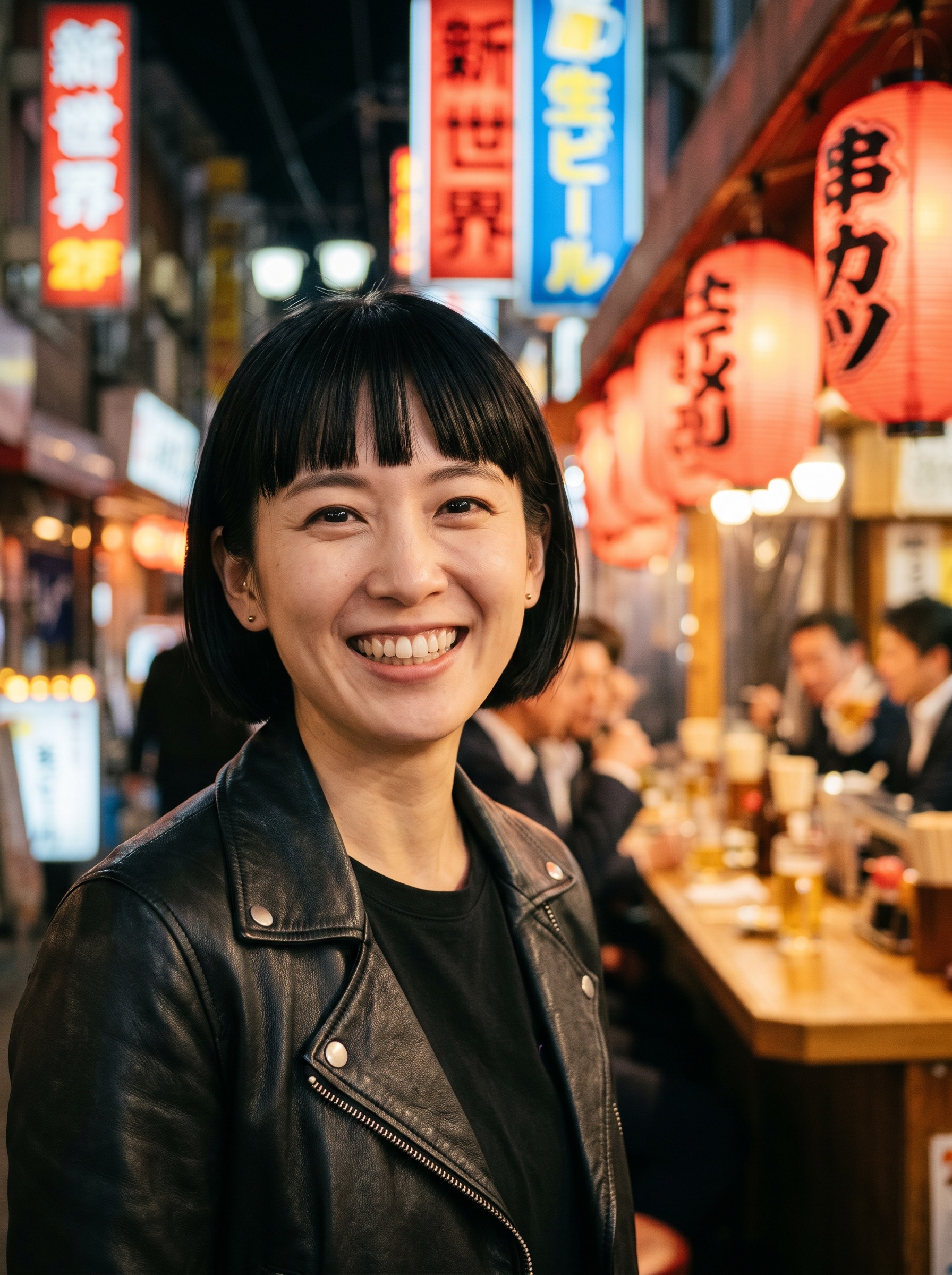
For the opposite mood, go under the tracks to Shin-Umeda Shokudogai, the 1950 alley crammed with nearly 100 tiny eateries and bars. This is where the district drops its tie and loosens its collar. Matsuba Sohonten has been serving stand-and-eat kushikatsu there for some seventy years, with skewers like beef, prawn, whiting and sausage from around ¥120. It is fast, salty, and gloriously unglamorous — exactly the sort of place where Osaka’s appetite feels most honest.

If you want to eat like a grown-up with a bigger budget, head south to Kita-Shinchi, Osaka’s refined restaurant quarter and its answer to Ginza. Michelin sits thick on the ground here, and the two-Michelin-star Kahala is the district’s most celebrated table, serving teppanyaki that blends Japanese, Western and Chinese influences. This is not where you come for noise. This is where you come when you want the city to put on a proper jacket.
Going out
Night in Umeda is split down the middle between polish and grit, and that split is half the fun. The local crawl lives in the Ohatsu Tenjin Ura-Sando, the back-alley tangle behind the Tsuyunoten shrine off the 300-metre Sonezaki Ohatsu Tenjin arcade. The lanes are packed with izakayas, oyster counters, Okinawan and Italian baru, and the craft-beer bar umbrella, which has repeatedly turned up on Guinness’s Best Pubs lists. It’s a proper yokocho crawl: no grand plan, just follow the noise and take the stool that opens up.

What makes it feel so Osaka is the speed. Drinks land quickly, the counters are tight, and nobody’s pretending this is a contemplative experience. It’s a place for a highball with ice cracking in the glass, for a quick plate of something smoky, for a second stop because the first one was too full and too loud and therefore perfect.
The under-the-tracks Shin-Umeda Shokudogai doubles as a drinking district after work, where standing beers and shochu move through a crowd of off-duty salarymen with the kind of efficiency Umeda does best. If the mood is right, that alley can feel like the city’s working pulse made visible.
For a more elevated version of the night, the department stores and hotels stack cocktail bars high above the crowds, while Kita-Shinchi runs on hostess clubs, wine bars and late kaiseki. It is expensive, discreet and very Osaka-establishment — the sort of place where the city’s power people go to talk softly over expensive drinks. And the nice thing about Umeda is that, whatever kind of night you choose, the station network keeps you covered. Rain? Fine. Last train? Fine. You can bar-hop through a downpour without ever opening an umbrella.
Things to do
The one thing you really should not skip is the Umeda Sky Building. Ride the exposed escalator that crosses the open gap between the towers, and the building starts to feel like an event rather than a viewpoint. At the top sits the Kuchu Teien (Floating Garden) Observatory, an open-air ring 173 metres up, spanning the 39th and 40th floors and the roof. Standard admission is about ¥2,000 for adults, and it stays open late — roughly 9:30 to 22:30, with last entry at 22:00 — which means sunset is the magic hour. By the time you reach the 39th floor, the Lumi Sky Walk starts to glow, its phosphorescent stones turning the floor into a little private constellation.
The view is the point, of course: the city spread out in hard-edged layers, the station complex below, the river of roads, the towers, the long evening fading into neon. But what makes it memorable is the ceremony of getting there. Umeda loves a bit of engineered drama.
Back toward the centre, the red HEP Five Ferris Wheel gives the district another landmark, a 106-metre-high wheel perched over the mall. It is closed for long-term renovation from mid-October 2025 until late April 2026, so check before you build a plan around it. When it is running, it’s one of those very Osaka things: a giant bright-red wheel bolted to a shopping centre, because why not.
The new green face of the district is Umekita Park at Grand Green Osaka, a 45,000-square-metre stretch of lawns, forest and waterfall by the station. It gives Umeda something it never really had before: space to breathe. Alongside it sits the Tadao Ando-designed VS. cultural venue, which adds a cultured note to all that glass and grass. This is the version of Umeda that wants to be not just a hub but a destination.
And then there is the old pause, the one that reminds you the district has been lived in for a very long time. The Tsuyunoten (Ohatsu Tenjin) Shrine has stood here for over a thousand years, and it is tied to Chikamatsu’s 1703 puppet tragedy The Love Suicides at Sonezaki. Today couples come to pray for matchmaking luck. In a neighbourhood this mechanical, it’s oddly moving to find a place built around longing.
{{ATTRACTIONS}}
Shopping
Shopping is Umeda’s core competency, and it does not really matter whether you mean luxury, trend, souvenirs or a snack for the train. The heavyweight pairing is Hankyu Umeda Main Store and Hanshin Umeda Main Store. Hankyu is the king of Kansai depachika, all polished abundance and serious food floors. Hanshin leans more casual, with basement food stalls and the beloved Snack Park, where the mood is less ceremony and more grab-and-go satisfaction.
Just over the station, Lucua Osaka and its sister Lucua 1100 form one of the country’s biggest fashion buildings, while the red HEP Five aims younger and trend-led. To the north, Grand Front Osaka and Grand Green Osaka add design shops, a large Patagonia and lifestyle stores, which is a very Umeda way of saying the district is still being improved, one retail cluster at a time.
Then there is the underground world. On a rainy day, or any day when you’d rather not face a crosswalk, the action moves below ground into the Umeda Dungeon. Whity Umeda is one of Japan’s largest subterranean shopping streets, stretching from Osaka Station toward Higashi-Umeda. Diamor Osaka brings a brighter, European-arcade feel with marble floors and themed streets. Hankyu Sanban Gai hides a retro maze of small shops and eateries beneath Hankyu Umeda Station. You can shop, eat and change trains here for hours without surfacing once, which is either a marvel or a mild test of character depending on your relationship with signage.
Where to stay in Umeda (Kita)
Umeda is the best-connected place to sleep in Osaka, and the hotel choice reflects that. The newest luxury sits inside Grand Green Osaka, where the Waldorf Astoria Osaka opened in April 2025 with André Fu interiors and a Peacock Alley lounge, alongside the Canopy by Hilton Osaka Umeda, which has a rooftop bar and a covered walk to the station. If your ideal Osaka base is sleek, new and linked to everything, this is the sweet spot.
Business and mid-range towers cluster tightly around Osaka Station and the Hankyu terminal, which makes life easy if you are arriving on the airport express or planning day trips. If you want something a little calmer and cheaper with some local character, look one district over to Nakazakicho or Fukushima, both a short walk or a single stop away.
Wherever you sleep in Kita, the rule is simple: stay within the covered station network if you can. The rain is easier, the luggage is easier, and the whole district makes more sense when you can move without stepping outside every five minutes.
{{HOTELS}}
Getting around
Umeda is the transport hub of western Japan, and that is exactly why people base here. JR Osaka Station sits at the centre, with the private Hankyu Osaka-umeda and Hanshin Osaka-umeda terminals plus the Midosuji and Tanimachi subway lines — Umeda, Higashi-Umeda and Nishi-Umeda — all interlinked. It is all very efficient, until it isn’t, and then the Umeda Dungeon nickname starts to feel less like a joke and more like a warning.
The upside is unbeatable reach. Dotonbori and Namba are about 10 minutes south on the Midosuji subway. Shin-Osaka, for the shinkansen, is one stop north. Kyoto is roughly 30 to 45 minutes on the Hankyu or JR lines, Nara around 45 minutes, and Kobe 20 to 30 minutes — all easy half-day trips. Kansai International Airport connects directly via the JR Haruka express or the airport bus from the station.
On the ground, the district is highly walkable and largely covered, but the multi-level maze can still disorient first-timers. Follow the coloured floor lines and the numbered exits, and if you are truly lost, surface to street level and re-orient off the Umeda Sky Building or the red HEP Five wheel. That’s the honest Umeda method: don’t fight the machine, learn its landmarks.
What Umeda feels like, in the end
Umeda is not the Osaka of lanterns and canal reflections. It is the Osaka of connections, escalators, department-store basements, and the sudden thrill of finding a tiny standing bar behind a shrine. It is corporate, cosmopolitan, and a little hard-edged, but never dull. The district rewards people who like things that work: trains, rain cover, good food, skyline views, and a late drink within walking distance of your hotel.
It also rewards curiosity. Because for all the glass and engineering, Umeda still has those old pockets of smoke and noise — the kushikatsu counters, the yokocho lanes, the shrine tucked behind the arcade, the alley where salarymen have been unwinding since 1950. That mix is the whole point. Umeda is not trying to charm you with nostalgia. It is showing off what Osaka can build, and then, very casually, letting you find the good stuff in the cracks.
FAQs
Is Umeda a good area to stay in Osaka?
Yes, especially if connections and shopping matter most. Umeda has Osaka’s densest cluster of hotels around Osaka Station, excellent rail links to Kyoto, Nara, Kobe and the airport, plus endless covered shopping and dining. It is more corporate and modern than Dotonbori, so if you want classic neon-canal Osaka, Namba may suit you better.
What is the Umeda Sky Building and is it worth visiting?
It is Hiroshi Hara’s 1993 twin-tower complex, linked by the circular Kuchu Teien, or Floating Garden Observatory, 173 metres up. You reach it via an exposed escalator between the towers. It is worth it for the 360-degree view, especially at sunset when the Lumi Sky Walk glows. Adult admission is about ¥2,000 and it stays open late, roughly until 22:30.
Is Umeda’s underground really that confusing?
It can be. The connected underground malls, including Whity Umeda and Diamor, are so extensive that locals jokingly call it the Umeda Dungeon. Five differently named stations and dozens of exits do not help. Follow the coloured floor lines, note your exit number, and if you get lost, come back up and re-orient using a landmark like the Umeda Sky Building.
What is Umeda best for?
Umeda is best for shopping, skyline views, transport connections and easy day trips. It is also a strong choice for travellers who like covered walkways, department-store food halls, and a base that makes getting around Kansai simple.