Osaka guide
Shinsekai, Osaka: kushikatsu, neon and the old Showa grin
Osaka’s loudest old quarter is still frying, flashing and cracking highballs around Tsutenkaku, where kushikatsu, retro arcades and cheap beer keep the Showa mood alive.
 By Yui Morimoto

Shinsekai smells of hot beef tallow before you even see the tower. That’s the first honest thing about it, and maybe the best. The name means New World, but the district has been happily stuck in its own old one since the 1950s, all Showa signage, painted Billiken faces and a 103-metre steel tower that rose from the ashes of an earlier copy of the Eiffel Tower. This is Osaka with its collar open: deep-fried, cheap-beer, big-character Osaka, and it never asks to be polished.
What Shinsekai is known for
Shinsekai was built in 1912 as a fairground quarter, with an Eiffel-inspired tower up north and a Coney-Island-style Luna Park down south. The fairground glamour didn’t last, but the district’s appetite did. What survived is the thing people come for now: kushikatsu, the skewered, battered, deep-fried ritual that Shinsekai helped make famous. Meat, vegetables, seafood, cheese — all of it gets a quick dunk in a communal sauce pot, and all of it obeys the rule that matters most here: no double-dipping. One dunk per skewer, because the sauce is shared. If you want more, use the free raw cabbage like a tiny edible spoon.
This is not a neighbourhood of restraint. Hand-painted signboards lean over the pavement with pufferfish, chefs and sumo wrestlers staring down at you. Fry-oil steam hangs in the air and never quite clears. The soundtrack is fryer sizzle, pachinko clatter from Kasuga Gorakujo and the occasional busker. Grandpas nurse lunchtime highballs. Families queue for skewers. Travellers keep looking up at the tower like they’ve just arrived at a very cheerful shipwreck.
Over all of it sits Tsutenkaku, the tower reaching heaven, rebuilt in 1956 by Tachū Naitō after the original was damaged by fire and scrapped for the war effort. It is octagonal, 103 metres tall and still the district’s anchor. On the fifth-floor deck, Billiken — the grinning good-luck imp — sits waiting for you to rub the soles of his feet for luck. In Shinsekai, even the superstition is fried crisp.

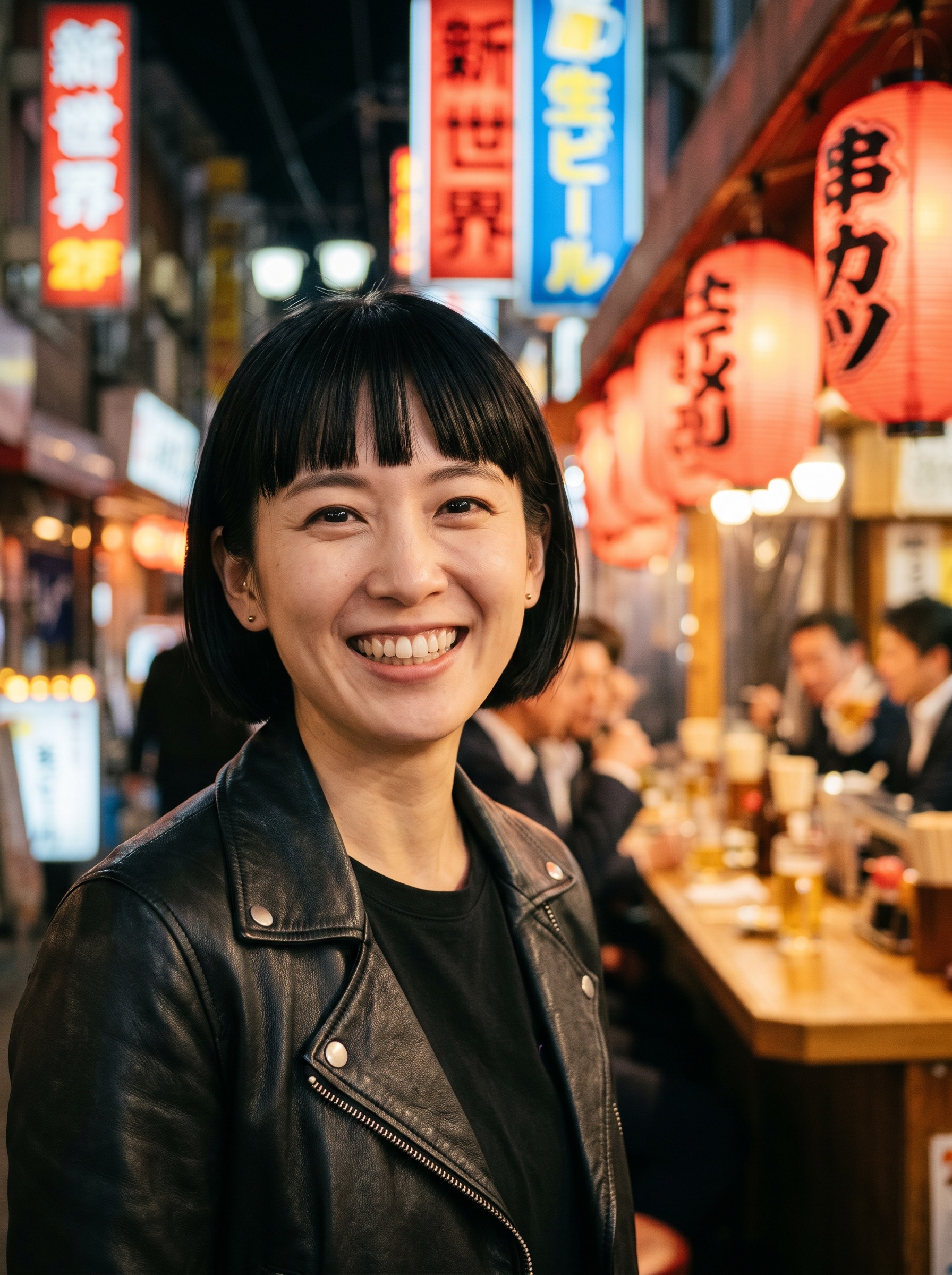
Jan-Jan Yokocho is the beating middle of the district, a 180-metre covered alley named for the twang of shamisen and taiko that once called punters in. It is scruffy in the best possible way. Retro arcades, standing bars, kushikatsu counters and old clubs for go and shogi all press together under the roofline, and after dark the neon doubles the light and turns the whole place into one of Osaka’s most photogenic corners.
Where to eat & drink
Start at the source. Kushikatsu Daruma opened in Shinsekai in 1929, originally as Takohachi, and its scowling-chef logo is as much a local landmark as the tower itself. The main branch near Tsutenkaku at 2-3-9 Ebisuhigashi fries in flavour-neutral beef tallow, so the skewers land lighter than they ought to. There are roughly 40 kinds, from beef and pork to onion, shrimp and shiitake, and a meal runs about ¥2,000–3,000 a head. It is the canonical Shinsekai stop because it knows exactly what the district is: quick, greasy, cheerful and unembarrassed.

A few steps away, Yaekatsu has been frying in Jan-Jan Yokocho since 1949 and remains beloved for its crisp batter and its onion skewer, which is the sort of thing Osaka does best: take a humble vegetable and make it the point. Expect a queue. Expect a strict house style that includes no phones while eating and no double-dipping. The room is older, the counter more no-frills, and the whole experience feels like the neighbourhood’s memory still has a pulse.
Next door, Tengu is the place to order doteyaki-kushikatsu. Doteyaki — beef tendon slow-stewed in miso — is one of Osaka’s great comfort dishes, and here it gets the extra pleasure of being skewered and fried. It’s the sort of thing you eat without making a speech, then immediately think about ordering again.
If you want the theatrical version of the district, Yokozuna at the Tsutenkaku branch leans all the way in. The facade is plastered with sumo wrestlers and Billikens, and the menu runs to 50-odd skewers at roughly ¥100–200 each, plus mega chanko hot-pot if you’ve arrived as a group. It’s loud, funny and knowingly over the top, which is to say: perfectly in character.
For a different kind of nostalgia, Ohsho Club revived a 1940s shogi hall as a kushiage bar, with shogi-board tables and a lighter, more modern fry. It’s the sort of conversion that only makes sense in a place like this, where old public amusements are never really allowed to die; they just get a second act with beer.
And when you need a break from skewers, Sennariya Coffee at the southern end of Jan-Jan Yokocho is the district’s quiet legend. The 1948 kissaten invented Osaka’s mixed juice by blending fruit and milk to use up over-ripe stock, and it still pours it alongside retro sandwiches and hot dogs. That drink tastes exactly like the kind of practical invention Osaka would turn into a signature: economical, sweet, and somehow more cheerful for having started as a solution.

If you want something savoury and more substantial, Grill Bon has been serving a thick beef-fillet cutlet sandwich for decades. It’s the sort of old grill that makes you slow down a little, not because it’s precious, but because it knows how to keep a good thing going.
Going out
Shinsekai’s nightlife is drinking, not clubbing. You do not come here to dress up and disappear into a velvet rope. You come to work the alley. Jan-Jan Yokocho and the surrounding lanes are the place to order a beer or a lemon sour, a plate of skewers and some doteyaki, then drift to the next standing bar before the ice has fully melted. Kushikatsu shops double as bars here, which is exactly the kind of practical Osaka logic that makes the neighbourhood feel alive even when you’re simply standing still.
The rhythm is convivial and unfussy. Shared tables. Salarymen unwinding with a highball. Tourists trying to understand the menu by pointing and smiling. Everyone eating with their hands. Daruma, Yaekatsu, Tengu and Yokozuna all keep pouring, and the smaller counters often run cheap highballs and doteyaki well into the evening. It is not a place for hushed conversation. It is a place for the clatter of glasses and the quick, teasing humour Osaka does so well.

It also isn’t a late-late district. Kitchens and the tower wind down earlier than Namba or Amerikamura, so Shinsekai works best as the first half of your night, the part where you eat too much, laugh too loudly and then head north for whatever comes next. Still, the walk after dark is worth lingering over. The lit-up Yokozuna facade and the tower’s changing weather-forecast lights give the whole district a theatrical afterglow, and the neon here has a way of making even a greasy pavement look cinematic.
Things to do and what to see
The obvious move is to climb Tsutenkaku Tower. The main observation deck sits around 91 metres up and gives you a 360-degree view over Osaka, with Billiken waiting on the deck for his foot-rub ritual. But the tower has become more playful in recent years. The Tower Slider, opened in 2022, is a 60-metre transparent tube slide that spirals from the third floor down to the basement. In 2024, DIVE & WALK added a controlled 14-metre drop-and-glide attraction. At the very top, the open-air TIP THE TSUTENKAKU deck costs a small extra fee. This is not a solemn monument. It is a tower that seems mildly delighted to be a tourist attraction.

At street level, Kasuga Gorakujo keeps the old arcade spirit alive. It has run in Jan-Jan Yokocho since 1959, entry is free, and most classic cabinets and medal games cost just ¥100 a play. The place has that lovely, slightly dusty energy of somewhere that has never needed to reinvent itself because it already knows exactly what it is.
A couple of minutes away, Spa World is a 24-hour bathing megaplex with themed European and Asian bathing zones, saunas and pools. The zones swap gender monthly, and visible tattoos are refused entry, which is worth knowing before you arrive with a plan and a sleeve. It’s one of those Osaka places that is both absurdly large and entirely matter-of-fact about being absurdly large.
On Shinsekai’s southern edge, Tennoji Zoo gives the district a different tempo. It opened in 1915 and is one of Japan’s oldest zoos, with entry at around ¥500. Nearby, Tennoji Park and Chausuyama offer green space and a free climb up a burial mound and 1615 battle site. If Shinsekai is the grease-and-neon face of the area, this is where the pace loosens a little and the city’s older layers show through.
{{ATTRACTIONS}}
Shopping & markets
Shinsekai is not a shopping district in the department-store sense, and that is part of its charm. You come here to browse, not to buy big. Jan-Jan Yokocho and Shinsekai Hon-dori are lined with kitsch that knows exactly who it is for: Billiken figurines and keyrings, tiger-print everything in honour of the Hanshin Tigers fans who pack the bars, retro sweets, and the painted-signboard souvenirs that photograph better than they age. It’s a place where the window display is often more fun than the purchase.
The best shopping here is snack-shopping. Senbei. Dried squid. Taiyaki. Tiny things you can carry while you drift between skewer stops and stand in the alley deciding whether you need one more beer. The point is not efficiency. The point is to let the district keep talking to you in signs, smells and little temptations.
If you want a proper market or serious retail, the Tennoji and Abeno district just east gives you Q’s Mall and Abeno Harukas department store, about a 15-minute walk away. But if you ask me, Shinsekai’s real retail theatre is at eye level: the hand-lettered menus, the old façades, the souvenir racks, the little objects that seem to have been designed to make you smile and spend ¥500 without thinking too hard.
Where to stay in Shinsekai
Shinsekai is one of Osaka’s cheapest places to sleep, and that is the whole pitch. The strip running from Dobutsuen-mae station toward Shin-Imamiya has become a run of budget and backpacker hotels and guesthouses, many with English-speaking reception, offering basic clean rooms at prices well below central Namba or Umeda. If you are travelling solo or keeping an eye on the budget, it is hard to beat the convenience of waking up already inside the district’s food-and-neon loop.
The trade-off is obvious. The immediate tourist core around the tower and Jan-Jan Yokocho is bright, busy and safe enough with normal city sense, but the budget-hotel belt edges into Nishinari and Airin, Osaka’s historic day-labourer quarter. It is safe in practice, but distinctly rough around the edges, and not the kind of base most families or first-time visitors imagine when they picture a comfortable city stay. That said, if you want the atmosphere without quite as much grit, some newer hotels sit right by Tsutenkaku itself.
{{HOTELS}}
Getting around
Shinsekai is compact and entirely walkable. The tower, the alleys, Spa World and the zoo are all within a few flat minutes of one another, which is part of why the neighbourhood works so well for a short stay or an easy evening out. You do not need a taxi to understand it; you just need a little stamina and maybe an appetite.
Three stations ring the area. Dobutsuen-mae, on the Osaka Metro Midosuji and Sakaisuji lines, is the handiest and about a five-minute walk into Jan-Jan Yokocho. Ebisucho, on the Sakaisuji line, drops you right by the tower. Shin-Imamiya, served by the JR Osaka Loop line and Nankai, is also about a five-minute walk and is useful if you are arriving by JR or heading toward Kansai International Airport.
Connections are excellent for somewhere this cheap. Namba is roughly four minutes north on the Midosuji line, and Umeda is about ten. For Kansai Airport, walk to Shin-Imamiya and take the Nankai line direct, or ride to Namba and change; figure on around 40–50 minutes door to airport. Day trips to Nara, Kobe and beyond are easy from the surrounding rail network too.
Shinsekai is not refined, and that’s precisely why it sticks. It is a neighbourhood that still believes in the pleasure of a hot skewer, a cheap drink, a painted sign and a tower that glows after dark. Osaka has many moods, but this one is among the most enduring: loud, greasy, theatrical and, on its own terms, completely sincere.
FAQs
Is Shinsekai a good area to stay in Osaka?
Yes — especially if you’re on a budget or want to stay close to kushikatsu, retro neon and Tsutenkaku, with Namba only about four minutes away by metro. Rooms are basic, though, and the budget-hotel strip edges toward the rougher Nishinari area, so it suits solo and cost-conscious travellers more than families wanting quiet and polish.
Is Shinsekai safe at night?
The main streets around Tsutenkaku and Jan-Jan Yokocho are well-lit, busy and generally fine with normal city sense. The old scary reputation is mostly history now, but the bordering Nishinari/Airin area feels grittier, so stick to the lively core, keep an eye on your belongings and avoid empty back lanes late at night.
What is the no-double-dipping rule in Shinsekai?
Kushikatsu here is served with a shared sauce pot, so each skewer gets one dunk only before you eat it. Dipping a half-eaten skewer back in is a no-go for hygiene reasons. If you want more sauce, use the free raw cabbage to scoop it up.
What should I eat first in Shinsekai?
Start with kushikatsu — Daruma, Yaekatsu, Tengu and Yokozuna are the names to know — then add doteyaki and, if you want a break from skewers, a mixed juice at Sennariya Coffee.