Luxor guide
West Bank - Al-Gezira, Luxor: the quiet side of the Nile
On Luxor’s West Bank, Al-Gezira is the village that trades nightlife for dawn access, rooftop dinners, and a front-row place to the Valley of the Kings.
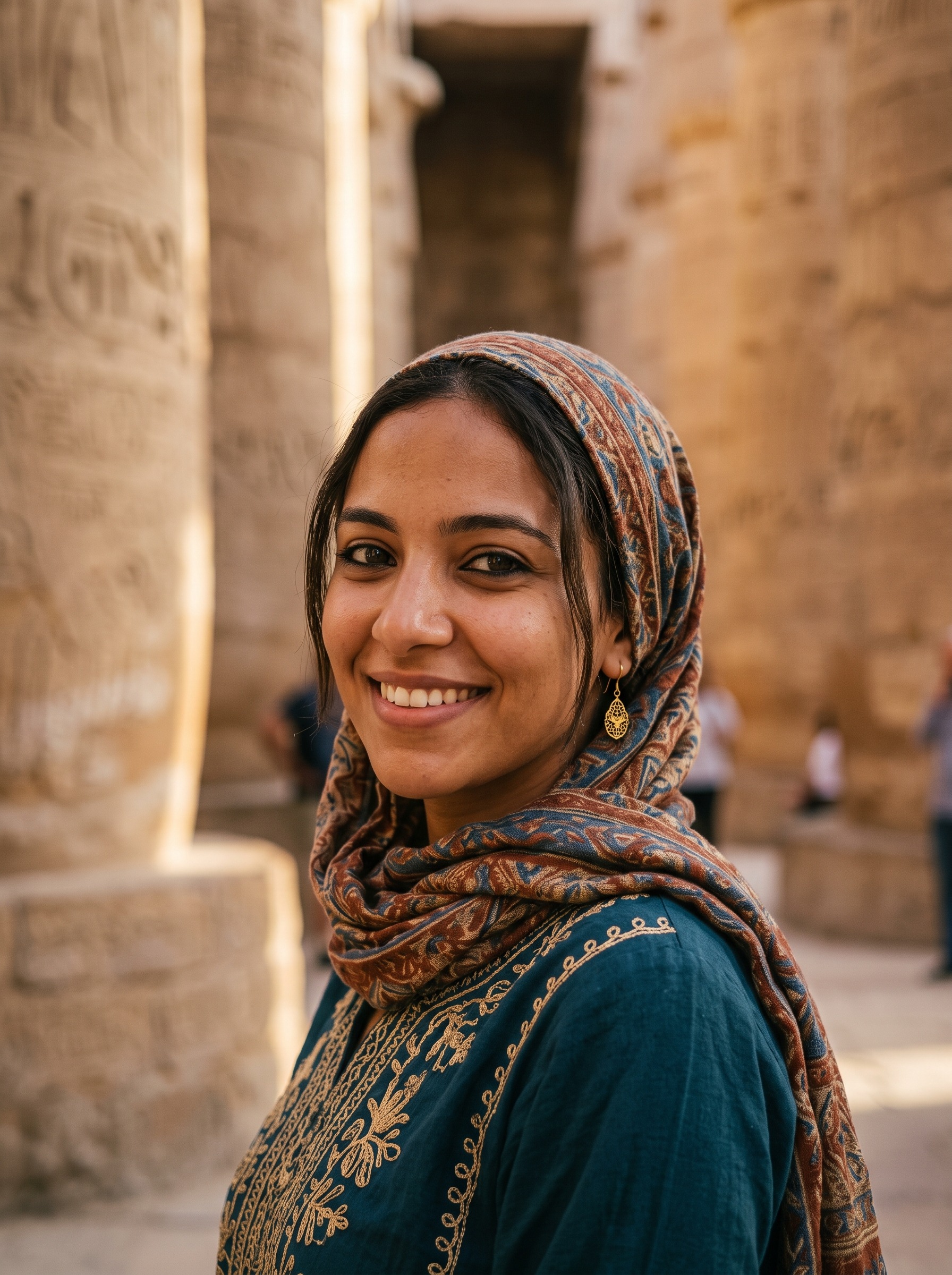

Step off the little green government ferry and Al-Gezira begins at once: a straight road, a few dusty lanes, sugarcane at the edges, and the Theban cliffs standing up in the distance like a painted backdrop that has gone on being dramatic for thousands of years. This is not the Luxor of neon and souvenir stalls. It is the quieter, rural side of the river, where the day starts with boats, bicycles and balloon baskets rising over the fields, and ends with mint tea on a roof as the western mountains turn apricot in the last light.
What Al-Gezira is known for
Al-Gezira is the West Bank’s front door, and that is not a poet’s phrase but a practical one. The public ferry from the East Bank docks here, and from the landing the village fans out into the landscape that makes people choose this side of Luxor in the first place. The road runs west past the Colossi of Memnon and on toward the ticket office for the tombs and temples, with the Valley of the Kings beyond. That geography is the whole argument for staying here: you sleep on the necropolis side of the Nile, so at 6am you can be moving toward the tomb gates before the coach groups have properly woken up across the river.

The village itself is modest, almost shy about its importance. There is a bike shop, a handful of guesthouses, a couple of rooftop kitchens, and enough everyday life to remind you that this is still a farming place first. Kids call hello from the fields. Donkey carts clip along dirt tracks. The road stays calm once you turn off the tarmac toward the monuments. And because the village sits on the necropolis side, the famous names are all close enough to feel almost domesticated: the Colossi of Memnon, Medinet Habu, the Ramesseum, Deir el-Bahari, the Valley of the Kings. The East Bank is still only a five-minute boat ride away when you want the temple-and-souk version of Luxor; here, though, the pace is slower, drier, and more honest about itself.
The other thing Al-Gezira has claimed for itself is the sunrise balloon ritual. Operators like Sindbad Balloons and Magic Horizon lift off from the West Bank fields, and from guesthouse roofs the sight can feel almost absurdly close — baskets rising while you are still in your slippers, the whole fleet drifting over the temples before breakfast. It is one of those Luxor experiences that can sound overdone in brochures and still be lovely when you see it done for real.
Where to eat & drink
Dining in Al-Gezira is rooftop and terrace territory, and it leans hard toward home-style Egyptian cooking. There is no menu theatre here, no attempt to pretend that the West Bank is a cosmopolitan dining district. The pattern is straightforward and comforting: soup, mezze, a main, fruit or something sweet, all eaten with a view of the river or the cliffs.
Sunflower Restaurant, right by the ferry dock, is the dependable first stop. It has rooftop Nile views, a traditional Egyptian set menu around LE91, cold drinks, and — unusually for this side of Luxor — a licence to serve beer and wine. That alone makes it a small landmark in a village that is otherwise content to stay quiet after dark.

Tutankhamun Restaurant, about 200 metres south of the landing, runs a similar seasonal fixed menu around LE90 and has a loyal following. The useful rule here is to agree the price before you order; a few travellers have found the menu less explicit than they would like. That said, it remains one of the classic easy dinners near the ferry, the sort of place where the meal is less about novelty than about sitting still long enough to watch the evening settle.
Africa Restaurant, up on the village’s main street in Gezira el-Bairat, is the long-running local favourite. It has both enclosed and rooftop seating, and the rooftop is the point: the views across to the East Bank are among the best on this side of the river. This is where the geography of Al-Gezira becomes part of dinner, not just the backdrop to it. You eat and keep glancing east as the light drains out of Luxor.
The hotels double as restaurants too, which suits a village like this. El Gezira Hotel serves Egyptian and international dishes over a garden, and people who are not staying there still come for the terrace. El Gezira Garden Hotel is especially well liked for its family-run rooftop kitchen; repeat guests praise the cooking as good as far pricier names across the water. In Al-Gezira, that kind of praise matters because it comes with the unspoken promise of something else too: nobody is rushing you off the roof.
Going out
Set your expectations properly and Al-Gezira becomes a pleasure. It has essentially no nightlife in the club-and-bar sense, and that is precisely why so many people base themselves here. This is a conservative farming village, and after dark the lanes empty out and go quiet. The evening ritual is simple: dinner on a roof, tea or shisha, then the sky.
There are a few places where a drink is possible. Sunflower Restaurant by the ferry is the most reliable for beer or wine, and some guesthouse terraces, including El Gezira Hotel, keep a small bar. But alcohol is the exception, not the rule. The bigger pleasure is the darkness itself: the western mountains are darker and clearer here than on the lit-up East Bank, and the fields around the village make the stars feel close enough to touch.
If you want a proper bar, a hotel lounge, or the floodlit spectacle of Luxor Temple after dark, you cross back over the Nile. The ferries and private motor-launches make that easy enough. But most people who choose Al-Gezira are not here to go out in the usual sense. They are here to end the day early and beautifully.
Things to do / what to see
The best thing about Al-Gezira is that almost everything you came to Luxor for sits within a short ride of the ferry. The obvious headline is the Valley of the Kings, about 10 kilometres inland, with a standard ticket around LE750 covering a rotation of tombs, and extra charges for Tutankhamun, Seti I and Ramesses V/VI. It is the site everyone knows by name, and yes, the name carries weight. But the real luxury of staying on the West Bank is not the prestige of saying you went there. It is getting there before the buses have turned the road into a queue.

Closer to the village, the Colossi of Memnon stand right on the main road from the ferry and are free to visit. They are huge, 18-metre quartzite statues of Amenhotep III, and they have the rare gift of being as plain in person as they are in the imagination: just enormous, weathered, and impossible to ignore.
Medinet Habu is one of the West Bank’s great rewards. Ramesses III’s mortuary temple is vast, well preserved, and still carrying surviving painted colour, which gives it an immediacy that some more famous sites have long since worn away. It costs about LE220 to enter, and it is the kind of place that makes you slow your pace without meaning to.

Deir el-Bahari, Hatshepsut’s terraced temple set into the cliffs, is another essential stop and one of the most striking approaches in Luxor. The temple seems to grow out of the rock itself, which is exactly the sort of thing ancient builders did when they wanted to impress and intimidate at the same time. The Ramesseum and the Valley of the Queens round out a full day or two of sightseeing, and Deir el-Medina, the artisans’ village, adds the human scale: the people who cut and painted the tombs lived here, which is a detail worth remembering when the royal necropolis starts to feel too grand for its own good.
The classic Al-Gezira way to link the closer sites is by bicycle. Mohamed’s Bike Shop, a short walk up from the ferry, rents good bikes with baskets, which is exactly the sort of practical detail that makes the village work. The roads to the Colossi, Medinet Habu, the Ramesseum and Deir el-Bahari are flat, quiet and paved, and cycling them in the morning light is one of the most agreeable ways to understand the West Bank’s layout. The longer, hillier ride to the Valley of the Kings is a different matter, so most people save their legs and take a taxi for that stretch.
The other unmissable experience is the sunrise balloon. Sindbad Balloons is one of the established operators, and the lift-off from the West Bank fields gives you a view down onto the temples and the Nile that is hard to improve on, even in a place as photogenic as Luxor. If you have ever wanted to see the landscape before it fully wakes, this is the hour to do it.

Back in the village, there is still one more sight worth making time for: your own guesthouse roof at sunset. In Al-Gezira, that is not filler time between activities. It is part of the day’s architecture.
{{ATTRACTIONS}}
Shopping & markets
Al-Gezira is not a shopping destination, and it is better for it. There is no tourist souk on this side, so if you want the covered market, spice stalls and alabaster shops, you cross to the East Bank. What the village has instead is more modest and more useful: small alabaster and stone workshops along the road toward the monuments, where craftsmen carve and polish vases and figures and will usually show you what they are doing before the hard sell begins. Prices are negotiable, quality varies, and the right approach is to buy the piece you like rather than any story attached to it.
Near the ferry and along the main lane, basic grocery kiosks, a bakery, water and snacks cover the practical needs of a day out. That matters more than it sounds, because once you are out among the temples there is little to buy. Bike hire is the local transaction that really counts here. Al-Gezira is not a place to shop; it is a place to stock up and keep moving.
Where to stay in West Bank - Al-Gezira
Al-Gezira’s lodging is overwhelmingly family-run and budget-to-mid-range, which is exactly why it has become the most popular West Bank base. The best places cluster around the ferry and the main village lane, close enough to the boat back to town and the road to the tombs that you stop thinking about logistics after the first day.
El Gezira Garden Hotel is the perennial favourite: a small family-owned place with around a dozen air-conditioned rooms, balconies, a flower garden, a rooftop restaurant and sunset views to the western mountains. It has the easy, lived-in quality that makes a guesthouse feel like an address rather than a transaction. El Gezira Hotel sits close to the water, with a garden, terrace, restaurant and bar, and the ferry access is as simple as it sounds. El Fayrouz Hotel, in Gezira el-Bairat, is a long-time favourite among visiting archaeologists, wrapped in palm and sugarcane with three rooftop terraces; it is cash only, which is useful to know before you arrive with the wrong assumptions. Amon Hotel, signposted from the ferry toward Pharaoh’s Stables, gives you a courtyard garden and a mid-range village base with the same practical West Bank logic.
{{HOTELS}}
For higher-end quiet, the boutique Al-Moudira lies further out toward the desert edge and the historic Marsam Hotel sits among the tombs in neighbouring Gurna, but both are a taxi ride from the Al-Gezira ferry rather than part of the village itself. That distinction matters. Al-Gezira is not where you come to be insulated from Luxor; it is where you come to be folded into its working geography.
Getting around
The lifeline here is the public ferry across the Nile between the East Bank Corniche and the Al-Gezira landing. It runs frequently, roughly every 15 minutes through the day, takes about five minutes, and costs a token fare. Locals pay a pound or two; foreigners are generally charged somewhere in the LE10–25 range, so small notes are useful and it never hurts to confirm before boarding. Private motor-launches also wait along the bank for around LE80–100 per boat if you miss the ferry or want to cross late.
On the West Bank itself, distances are longer than they look on a map. It is about 4 kilometres from the ferry to the ticket office and roughly 10 kilometres to the Valley of the Kings. That is why bicycles and taxis are the two tools that matter. Mohamed’s Bike Shop is the classic rental stop for the flat, quiet roads to the Colossi, Medinet Habu, the Ramesseum and Deir el-Bahari. For the uphill haul to the Valley of the Kings, most people use a taxi, and a half-day car with a driver runs a few hundred pounds. There is no West Bank rail or metro, which is part of the village’s charm and part of its inconvenience.
If you are flying onward, Luxor International Airport is on the East Bank, roughly a 30–40 minute drive once you have crossed. That means the ferry has to be folded into your timing, or you arrange a car and a separate river crossing for early flights. Al-Gezira rewards the traveller who plans a little and then forgets about it. Everything else is the river doing what it has always done.
Final word
Al-Gezira is not Luxor’s show-off side. It is the side that lets the monuments arrive in the right order: first the river, then the road, then the cliff line, then the tombs. If you want nightlife, walkable souks and a city buzz, stay across the water. If you want a quiet base with early access to the Valley of the Kings, home-cooked dinners on a roof, and the sight of balloons rising over the fields before breakfast, this is the place that makes the most sense.
It is rural, a little rough around the edges, and all the better for it. The West Bank does not need polishing to be magnetic. It needs time, and a ferry ticket.
FAQs
Is West Bank - Al-Gezira a good place to stay in Luxor?
Yes, if you want quiet and quick access to the monuments. Al-Gezira is the most popular West Bank base: friendly, affordable guesthouses minutes from the ferry and a short ride from the Valley of the Kings, Medinet Habu and the mortuary temples, plus front-row seats for the sunrise balloons. The trade-off is that it’s rural and largely dry, with no nightlife and no walkable souk or temple — you cross to the East Bank for those.
How do I get from Al-Gezira to the East Bank and the temples?
The public ferry crosses the Nile between the Al-Gezira landing and the East Bank Corniche roughly every 15 minutes, takes about five minutes and costs only a few pounds for locals; foreigners are typically charged around LE10–25. Private motor-launches also wait along the bank for about LE80–100 per boat. On the West Bank side, hire a bike for the flat sites near the village and take a taxi for the longer, hillier trip up to the Valley of the Kings.
Where can I eat and drink in Al-Gezira?
Dining is rooftop and set-menu Egyptian, all near the ferry. Sunflower Restaurant by the dock does a traditional set menu around LE91 with Nile views and is one of the few spots licensed for beer and wine; Tutankhamun Restaurant nearby runs a similar fixed menu around LE90, but agree the price first; and Africa Restaurant up on the main street has great East Bank views. The El Gezira and El Gezira Garden hotel rooftops also serve well-liked home-style dinners.
What is Al-Gezira best for?
It’s best for sunrise access to the Valley of the Kings and the West Bank temples, relaxed rural guesthouse stays, and hot-air ballooning. It suits travellers who want calm, early starts and easy cycling between nearby sites more than nightlife or shopping.