Agra guide
Taj Ganj, Agra: the lanes that live in the Taj Mahal’s shadow
A close-up look at Agra’s most compressed neighbourhood, where marble inlay, rooftop chai and pre-dawn Taj walks shape every day.
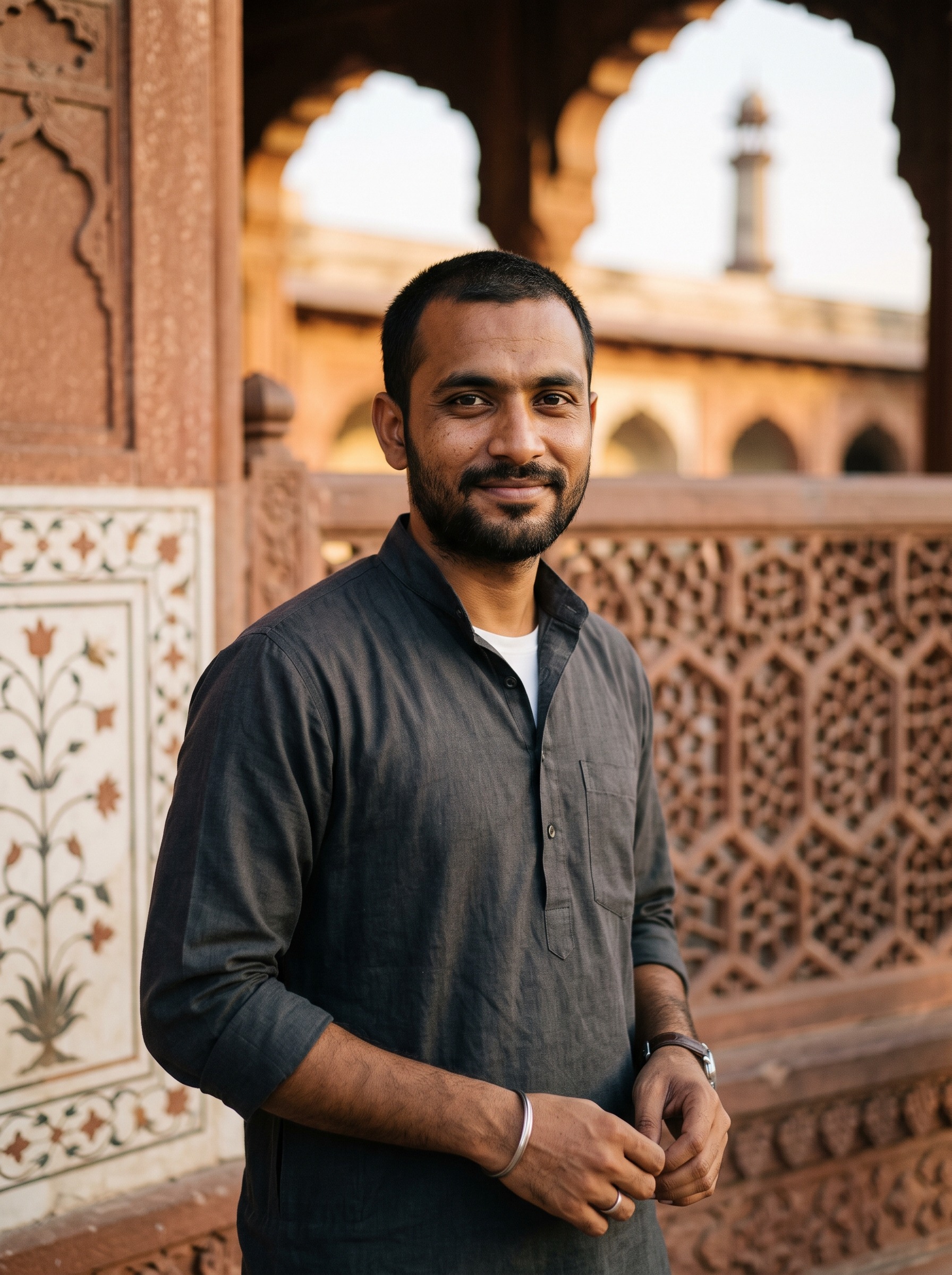

The first thing you notice in Taj Ganj is not the Taj Mahal itself, but the sound of the place waking up: a bicycle bell, a muezzin call, the scrape of a shutter rolling open on a tea stall, and then, somewhere above the lane, a rooftop chair being dragged into position for the dawn. The mausoleum is so close here that the neighbourhood feels like it is leaning toward it. In the dark, you can walk to the ticket line before the marble changes from grey to pink, and by sunrise the whole quarter seems to tilt upward in expectation.
Taj Ganj began as Mumtazabad, the planned bazaar town Shah Jahan built to house the twenty-thousand-odd masons and stone-carvers who raised the Taj in the 1630s. That origin still hangs in the air. The lanes are low-rise and dusty, dense with guesthouses, marble-inlay workshops, souvenir stalls and tea shops, and the old craft has not been embalmed behind glass. It is still being done, a few doors from the beds where today’s travellers sleep. This is not polished Agra. It is the city at its most concentrated, most practical, most visibly dependent on the monument beside it.

What Taj Ganj is known for
Taj Ganj is known first for proximity. The guesthouse lanes off Chowk Kagziyan sit roughly 350 metres from the mausoleum, which means that staying here is not a vague promise of convenience but a literal shortcut to the gate. Backpackers figured that out decades ago, and they have been clustering here ever since. If you are the sort of traveller who wants to be at the pre-dawn queue rather than in a taxi cross-town, this is the neighbourhood that makes that possible.
It is also known for the rooftops. The quarter is bound by the low-rise rules that protect the Taj’s sightlines, and the consequence is a skyline of terraces angled at the dome. Every second building seems to have a café or guesthouse roof with a chair pointed toward the marble. At breakfast, the trade is not just tea and toast but tea and the Taj. At dusk, people sit with a cold drink and watch the monument shift through orange, pink and bone. The view is the currency here, and the rooftops are the neighbourhood’s most persuasive argument.

The third layer is the oldest and most interesting: the craft. This was Mumtazabad, the Mughal service town built to support a huge workforce, and the old trade quarters still survive in the names of lanes and katras. Resham Katra, Katra Fulel — these are not decorative historical labels but traces of a working bazaar city. More importantly, the marble-inlay tradition that decorated the Taj itself still lives here in cramped workshops, often run by families who say they descend from the original karigars. The souvenir boxes and tabletops that line the lanes are not just tourist stock; they are the living tail of that lineage.
What makes Taj Ganj compelling is that all three versions of the place — the budget bed base, the rooftop-view economy and the artisan quarter — still overlap in the same few hundred metres. You can arrive for one night, chase the sunrise, buy a marble box, and leave with the sense that you have only brushed the surface of a neighbourhood that has spent centuries orbiting a single building.
Where to eat & drink
Eating in Taj Ganj is not about culinary discovery in the grand sense. It is about finding the right rooftop, the right thali, the right kitchen that has been doing the same thing long enough to deserve trust. The neighbourhood feeds travellers, and it does so with a kind of practical repetition that becomes comforting after a day of dust and monument-watching.
Joney’s Place is the sentimental classic, a shoebox kitchen near the South Gate that has been going since 1978. It is famous for its banana lassi — the “money-back” version, as the legend goes — and for malai kofta cooked in front of you in a mini-kitchen and served in generous, cheap portions. It is the sort of place that survives on memory as much as on food, but the memory is earned. The room is tiny, the movement constant, and the appeal is precisely that it feels like an institution without ever pretending to be anything more than a good, honest traveller’s stop.
Shankara Vegis, open since 1992, is the steadier vegetarian choice. Downstairs there is a calm air-conditioned room; above it, a 360-degree rooftop with a partial Taj view. The thalis are very good and start from around ₹140, and the free wi-fi makes it especially easy to linger. In a neighbourhood full of noise and sales pressure, Shankara Vegis feels like an oasis with a menu.

For the classic breakfast-with-a-view ritual, Saniya Palace is the name that keeps coming up. Its rooftop terrace looks straight across the low roofs to the dome, and it is at its best in the morning when the light is still soft and the crowd has not yet thickened. Hotel Kamal, meanwhile, is generally regarded as the smartest address in Taj Ganj proper, with a rooftop restaurant and a strong full Taj view. Chia Taj View Cafe adds a slightly different note with an Indian-and-Korean menu and a well-reviewed outlook over the dome.
If you want to make the evening feel more like a night out than a pause between sightseeing and sleep, The Salt Cafe Kitchen & Bar on Fatehabad Road is the place that stretches the local rhythm. It is a large Santorini-styled rooftop bar-and-grill, licensed, multi-cuisine and open to around midnight, long after the lanes around the Taj have gone quiet. The menu runs from Indian to Continental, Asian to Italian and Mexican, but the real draw is that it gives the quarter something it mostly lacks: a proper bar with a little late-night atmosphere.

Going out
Taj Ganj is not a neighbourhood that believes in staying up late. The Taj complex itself closes by 6.30 to 7pm, and the lanes follow suit not long after dinner. There is no club scene here, no pulse that runs past midnight unless you count generators and the occasional late rickshaw. A night out in Taj Ganj is usually a sunset drink, a rooftop perch, and an early retreat before the 5am alarm for sunrise.
That said, the evening has its own modest pleasures. Most guesthouse terraces will happily produce a cold Kingfisher while the marble turns orange. The one place organised as a genuine bar is The Salt Cafe Kitchen & Bar, which has live music and DJ evenings on its rooftop and holds a drinks licence. It is the outlier that proves the rule: if you want a proper bar and a later finish, Taj Ganj can provide one, but only in a way that still feels tethered to the neighbourhood’s early-to-bed rhythm.
Elsewhere, drinking is low-key by necessity. Many small budget places are unlicensed or dry, and alcohol is not sold openly in the immediate temple-and-tomb vicinity. The honest way to approach the area after dark is not as a party district but as a place for a sunset and an early night. If you want a polished lounge scene, the better-known hotel bars sit on Fatehabad Road. Taj Ganj itself is happier with a view than a volume knob.
Things to do / what to see
The obvious thing is also the reason the neighbourhood exists as a destination: the Taj Mahal at sunrise. Staying in Taj Ganj means you can walk to the ticket line before opening, around 6am, and be on the platform as the light begins to warm the marble. The South Gate beside the lanes is now exit-only, so entry is via the West Gate, which is the nearest, or the quieter East Gate. The final approach is on foot or by cycle-rickshaw or battery cart, because the last 500 metres are a no-emissions zone. The experience is less about arrival than about the slow compression of expectation as the monument appears.

A Taj Heritage or food walk is the best way to understand the neighbourhood beyond the monument. These guided early-morning or evening walks move through the old Mumtazabad bazaar lanes, the inlay workshops and the hidden viewpoints that appear and disappear between rooftops. The value of a guide here is not just information but memory: people who have lived in the quarter all their lives can read the history that the map leaves out.
Watching artisans cut pietra dura is worth an hour on its own. In the marble-inlay workshops, karigars set carnelian, malachite and lapis into marble by hand, the same living craft that decorates the Taj. Even if you buy nothing, the work itself is the point: the emery wheel, the careful fit, the patience required to make stone behave like thread. Taj Ganj’s souvenir trade can be pushy, but the workshops are where the neighbourhood’s most serious inheritance is still visible.
For a change of pace and a little green, the Taj Nature Walk sits just off Taj East Gate Road. It is a small forested reserve with birdlife and marked Taj viewpoints, and it offers a less crowded angle on the monument. The other classic add-on is Mehtab Bagh across the Yamuna, the Moonlight Garden, where a late-afternoon tuk-tuk ride brings you to a head-on sunset view of the Taj from the far bank. It is the counterpoint to the sunrise ritual: same monument, different mood, broader horizon.
{{ATTRACTIONS}}
Shopping
Shopping in Taj Ganj means marble inlay before almost anything else. The lanes are lined with workshops and showrooms selling pietra-dura tabletops, coasters, jewellery boxes, plates and elephants, all inlaid with semi-precious stone in the same tradition used on the Taj’s own panels. The craft is real, but so is the salesmanship. Quality varies wildly, and the tourist versions of the object can be very different from the thing being demonstrated in the workshop.
The trick is to slow down. Genuine marble is heavy and cool, and it can look translucent at the edges when held to light. Cheap soapstone and resin are often passed off as the real thing, and prices for tourists start high. Bargain firmly, ask to watch a piece being made, and do not feel obliged to buy from the first “government-approved” showroom a rickshaw driver suggests. Commission is built into the theatre here, and a polite skepticism will save you both money and irritation.
Beyond marble, the stalls carry the usual souvenir spread: miniature Taj models, textiles, leather, brassware and Mughal-print scarves. Taj Ganj is a place to browse and haggle rather than a serious market. If you want the fuller bazaar experience, with petha sweets, chaat and leather, Sadar Bazar in the Cantonment or the wholesale lanes of the old city near Agra Fort are the better bets.
Where to stay in Taj Ganj
Taj Ganj is Agra’s budget-and-backpacker bed, and the reason to stay here is simple: you can walk to the Taj at dawn. Rooms in the ₹600–1,500 range are the norm, with dorm beds cheaper still, and the best value comes not from luxury but from location. The prize is a room, or at least a rooftop, with a genuine Taj view. That view is often advertised more generously than it exists, so it is worth confirming the sightline before you book.
Hotel Kamal is generally the smartest option in Taj Ganj proper, with a rooftop restaurant and a strong full Taj view. Saniya Palace remains a long-standing backpacker favourite, with AC and non-AC rooms, dorms and a terrace facing the dome. Hotel Sheela, set around a garden very close to the gate, is another well-liked budget pick and tends to feel a little quieter, though not all rooms have the view.
Pick a room set back from the mosque and the busiest lanes if you are a light sleeper. Early calls to prayer and rooftop generators carry. And if a rickshaw driver tells you your hotel is full, closed or suddenly unavailable, treat it as what it usually is: a commission scam designed to steer you elsewhere. Taj Ganj is honest about its rough edges. The trick is to book accordingly.
{{HOTELS}}
Getting around
Taj Ganj is a place to walk. The quarter is small, and the last stretch to the monument is a no-emissions zone where petrol and diesel vehicles are banned. That means the approach is on foot, by cycle-rickshaw, horse tonga or battery-cart shuttle. If you are entering on a foreigner ticket, the battery-bus or golf-cart lift from the parking area to the gate is included. The West Gate is the nearest entry from the South Gate lanes, while the East Gate is quieter but a little farther and usually reached by a quick e-rickshaw hop.
Beyond the neighbourhood, Agra is close enough that day trips are easy to stitch together. Agra Cantt railway station is roughly 15 to 20 minutes away by auto or taxi, and the prepaid taxi counter is the sensible choice there. Agra Fort is about 10 to 15 minutes by road. Mehtab Bagh across the river takes around 20 to 30 minutes. Fatehpur Sikri, about an hour west, is a straightforward day trip arranged through most guesthouses.
The same advice applies everywhere here: agree tuk-tuk fares before you get in, use a metered app cab when you can, and ignore the standard patter about the Taj being closed today, a special sunset spot, or a brother’s marble factory. Most of it is sales, not fact. Taj Ganj is safe in the ordinary sense, but it rewards travellers who keep their wits and their wallet close.
In the end, that is the neighbourhood’s bargain. Taj Ganj is dusty, dense and sometimes exhausting, but it gives you something money cannot buy elsewhere in Agra: nearness. It gives you the chance to wake before dawn, walk out through low lanes, and stand in the first light while the Taj Mahal turns from grey to pink as if the whole quarter had been built for that single colour change.
FAQs
Is Taj Ganj a good area to stay in Agra?
Yes, if you want budget beds and the shortest possible walk to the Taj Mahal at sunrise. The trade-off is that Taj Ganj is dense, dusty and hustle-heavy, with simple guesthouses rather than polished hotels. If you want more comfort, a pool or a broader restaurant scene, base yourself on Fatehabad Road or Taj East Gate Road instead.
Can you walk to the Taj Mahal from Taj Ganj, and which gate do you use?
Yes — that is the whole point of staying here. The South Gate beside Taj Ganj is exit-only, so you enter via the West Gate, which is nearest, or the quieter East Gate. The last 500 metres are a no-emissions zone, so the final approach is on foot or by cycle-rickshaw or battery cart.
Is Taj Ganj safe?
It is generally safe and walkable by day and early evening. The main issue is not crime but constant touts, commission scams and sales pressure. Be firmer than polite, agree fares before you ride, and avoid unlit back lanes late at night.
What is the best time to visit the Taj from Taj Ganj?
Sunrise is the prize. If you leave early, you can reach the ticket line before opening, around 6am, and catch the marble as it turns pink and gold. The Taj is closed every Friday.